Custom Web Applications
Software for the part of your business a website can't reach
There is a point where a website stops being the answer and what you actually need is software: a dashboard showing what is happening, a booking system that prevents double-bookings, a portal your customers log into, an internal tool replacing a spreadsheet that three people email around. That is a different kind of build, with users, permissions and data that has to stay correct.
the problem
The problems this solves
- Your operation runs on a spreadsheet that several people edit and nobody fully trusts.
- Bookings or orders arrive through scattered channels with no single reliable record.
- Staff spend hours re-typing the same information between systems.
- Off-the-shelf software nearly fits, and the gap is where all the manual work lives.
what's included
What's included
Admin dashboards
A private interface showing what is actually happening, built around the decisions you need to make.
User accounts and permissions
Roles configured so people can see and change exactly what they should.
Booking and scheduling logic
Availability and conflict rules that hold up under real use rather than only in the happy path.
Data integrity
Validation and constraints so the records stay trustworthy as volume grows.
Integrations
Connecting the systems you already use, so information stops being re-typed.
Documentation and training
Written handover, because software nobody understands gets abandoned.
benefits
What this changes day to day
One source of truth
Everyone looking at the same data instead of reconciling three versions of a spreadsheet.
Hours back each week
Manual re-entry and status-chasing replaced by something that just holds the information.
Errors caught at entry
Validation stops bad data getting in, which is far cheaper than correcting it later.
Visibility into the operation
Seeing what is actually happening without asking three people.
Software shaped to you
Built around your process rather than bending your process around a product.
who it's for
Who this is for
- Businesses whose operations have outgrown spreadsheets and shared documents
- Organisations needing customers or members to log in and see their own information
- Teams handling bookings, orders or scheduling where conflicts are expensive
- Anyone paying for software that only does two thirds of what they need
process
How the work runs
Map the real process
How the work happens now, including the informal workarounds. Those workarounds usually reveal the actual requirement.
Define version one
The smallest build that genuinely replaces the current process. Everything else is a later release.
Data model
Getting the structure right early, because this is the most expensive thing to change later.
Build in stages
Working software you can try at each stage, rather than a reveal at the end.
Test with real data
Including the awkward edge cases that break assumptions.
Rollout and training
Moving your team across deliberately, with support through the transition.
honest scoping
When this isn't the right fit
We would rather tell you now than take on work that was never going to serve you.
- Existing off-the-shelf software genuinely covers your needs — buying it will be cheaper than building.
- The underlying process is unclear. Software will make an unclear process worse, faster.
- You need it in three weeks. Applications take longer than sites, and rushing the data model is expensive.
- Nobody internally will own it. Applications need somebody responsible for them after launch.
ghana & accra
Building operational tools in Ghana
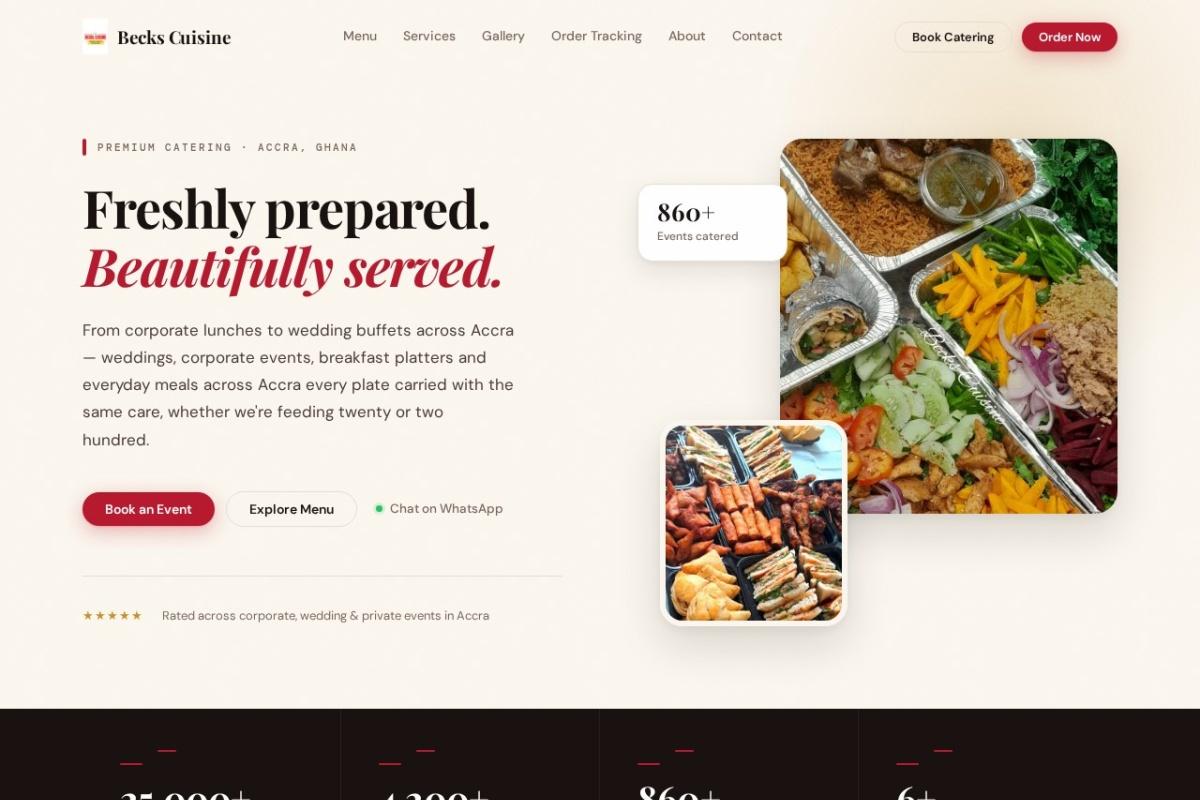
The businesses here that benefit most from custom tools are usually the ones running a real operation on WhatsApp threads and shared spreadsheets — catering, logistics, property, professional services. The Becks Cuisine admin dashboard came directly out of that pattern: enquiries and orders arriving across scattered channels with no single place to see what had been committed to. Practical constraints matter too, since staff often work from phones rather than desktops, so these interfaces get built to be usable on a small screen.
proof
Work that shows this in practice
Real projects where this service did the heavy lifting.
questions
Frequently asked
How is this different from a website?
A website presents information to visitors. An application does work: it holds data, enforces rules, and has users who log in. The build is longer, testing matters far more, and the data model is the part that determines whether it stays maintainable.
Can you build this on top of my existing site?
Often yes. An admin dashboard or customer portal can sit alongside a site you already have, sharing branding without requiring the public site to be rebuilt.
How long does an application take?
Longer than a website, and genuinely dependent on scope. Defining a tight version one is what keeps it predictable — the common failure is trying to build everything at once.
What if my requirements change during the build?
They usually do, because seeing working software clarifies thinking. Building in stages exists precisely so change is absorbed rather than treated as a crisis.
Will I be locked into you for changes?
No. You get the code, documentation and all access. Any competent developer can pick it up, which is the standard the handover is written to.
related
Services that often go together
Web Development
A website should do work: bring in enquiries, answer the questions your customers keep asking, and make your business look like the serious operation it is.
Ecommerce Development
An online store has a harder job than a normal website: every extra second of load time and every confusing checkout step costs you a sale you had already won.
Mobile App Development
Most organisations do not need two separate native apps — they need one product that works properly on both iOS and Android.
Website Maintenance
Websites are not finished objects.
Need custom web applications?
Tell us what you're working with and we'll give you an honest view of scope, timeline and whether this is the right service for the problem.